
For Michigan’s secondary school leaders, recent years have brought a sobering reality to the foreground. According to 2023–24 MDE data, while statewide attendance has seen a slight uptick to 90.8%, chronic absenteeism remains a significant hurdle. For high school principals, these numbers aren’t just statistics; they represent empty desks and crowded hallways.
We often treat “attendance” and “behavior” as two separate silos. But if you look at the daily reality of a Michigan high school, these problems are the same. When a student is “drifting” in the hallway, avoiding class, lingering in restrooms, or wandering between buildings, they are physically absent from instruction.
This is the “Visibility Gap”, and it is the single greatest threat to your school culture.
The Accountability Mandate
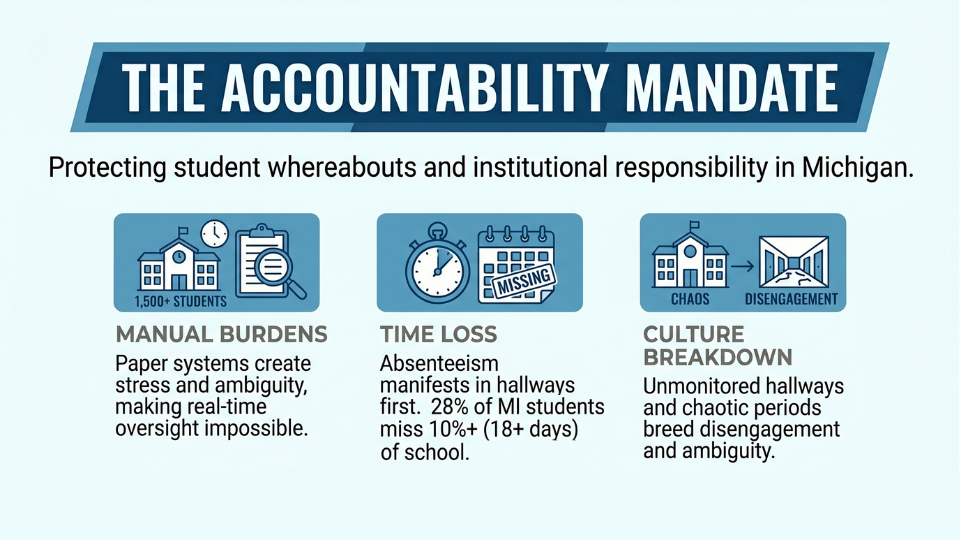
Under Michigan’s Compulsory Attendance Law, schools are responsible for student whereabouts throughout the instructional day, including managing tardies, hall passes, late check ins, or early check outs. But in a building of 1,500+ students, “responsibility” is often a manual, high-stress game of catch-up. Manual systems like paper hall passes and verbal ‘OKs’ create a culture of ambiguity. When you can’t see where your students are, you can’t protect their time.
A recent article highlights that 28% of Michigan students missed 10% or more of the 2024 school year. That’s at least 18 days. This absenteeism and disengagement often manifest in the hallways before they ever reach the classroom. When hallways feel unmonitored or passing periods feel chaotic, students perceive a lack of accountability. This isn’t just a discipline issue; it’s a breakdown in the infrastructure of the school day.
Replacing “Gotcha” Discipline with a Culture of Accountability
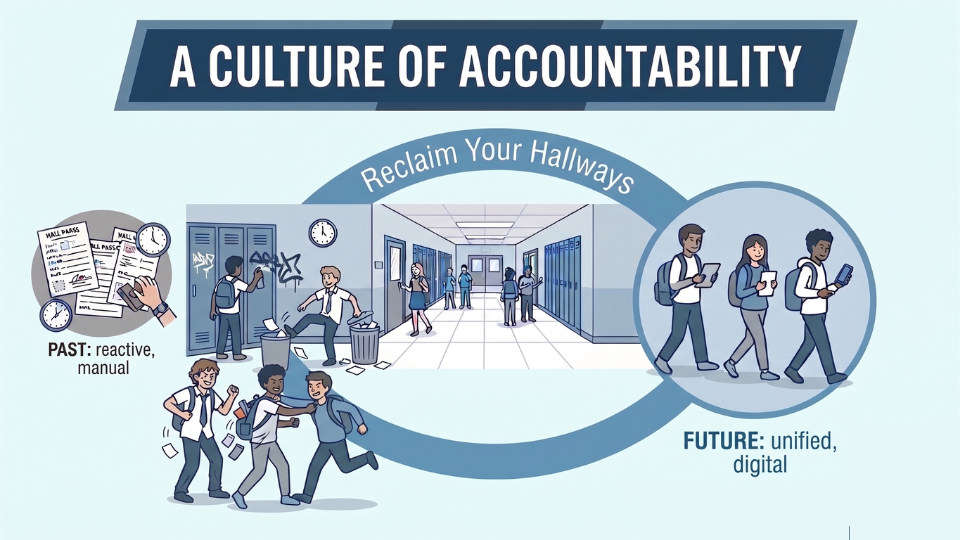
To reclaim the hallways, we have to move beyond reactive discipline. The goal isn’t to “catch” students doing something wrong; it’s to build an environment where doing the right thing, being in class on time, is the path of least resistance.
By shifting from manual tracking to a unified digital infrastructure, Michigan schools are seeing success in three key areas:
1. Closing the “Hallway Drift”
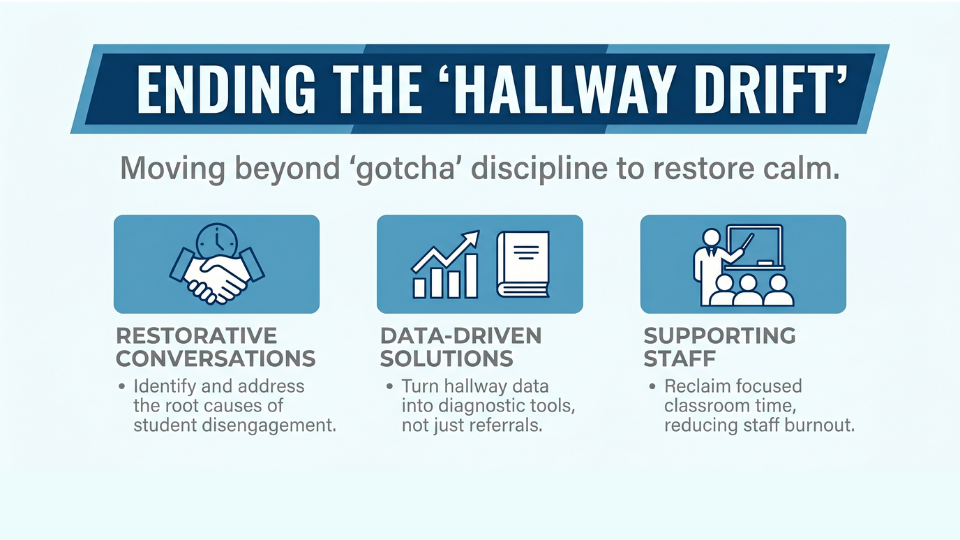
Digital movement tools provide a real-time audit trail that paper can’t match. If a student is chronically out of class, you don’t need a disciplinary referral to act. You have the data to start a restorative conversation: “I noticed you’ve spent 90 minutes in the hallway this week. What’s happening in third period that makes you want to leave?” This transforms a “gotcha” moment into a diagnostic tool to address the root cause of disengagement.
2. Protecting Instructional Time
In many Michigan districts, five tardies now equal one unexcused absence. When tardy tracking is automated and instant, it moves the burden off the teacher. It becomes a consistent, school-wide habit rather than a classroom-by-classroom negotiation. This consistency is what builds good habits and a better culture; it tells students that every minute of instruction is valued.
3. Stabilizing Staff Morale
We know that about one-quarter of public school leaders report that student disengagement has a severe negative impact on staff morale. Teachers are at their best when they can teach. By tightening the hallways, we give them back their most precious resource: a classroom that isn’t constantly interrupted by late arrivals and unauthorized roamers. When the hallways are calm, the classrooms are focused.
The Strategic Shift: Infrastructure over Rules
Rules tell students what not to do. Infrastructure makes it clear what they should do. As Michigan educators look toward the next school year, the focus must shift from adding more rules to creating better hallway visibility.
When you know exactly who is in the hall and why, you aren’t just managing movement; you are protecting your school’s mission. You are ensuring that “instructional time” isn’t just a phrase in a handbook, but a protected reality for every student.
Ending the Hallway Drift and Restoring Instructional Calm
The transition from chaos to culture doesn’t happen through a single assembly or a new set of consequences. It happens when expectations are visible, systems are consistent, and staff feel empowered.
When every student knows they are seen, the “daily chaos” begins to quiet. We aren’t just tracking movement; we are reclaiming the 180 days we have to change these students’ lives. Let’s start building the structures that allow Michigan students to thrive.